Electrical Inspection Documentation for Electricians: A Video-First Workflow to Pass Inspections and Protect Profit
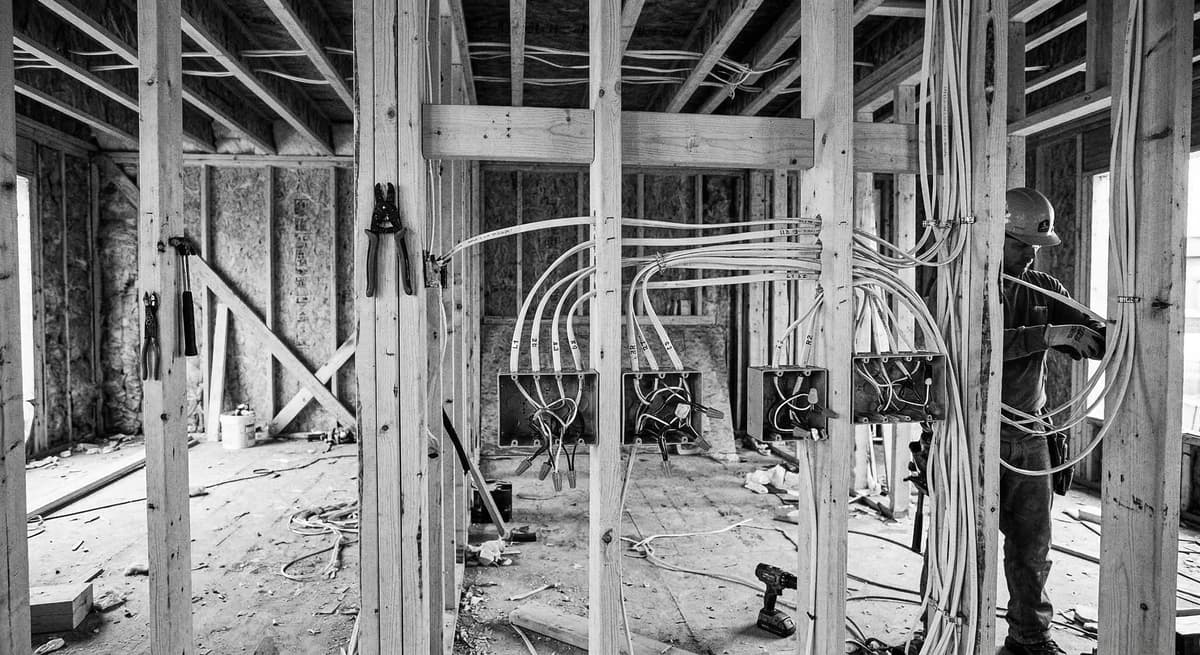
A single failed electrical inspection doesn't just cost you the re-inspection fee. For a small shop, it triggers a cascade, unbillable labor to return and fix the cited item, windshield time, fuel, and a schedule delay that ripples out to the GC, the drywall crew, and every trade behind you. Some jurisdictions double re-inspection fees with each failure. Factor in a half-day of lost production and the real hit on a one-to-ten person shop can easily reach $500 to $800, straight out of profit.
The fix is a five-minute video walkthrough before you call for inspection. Done right, it catches the common flags before the inspector sees them, and it gives you timestamped evidence if anything ever gets disputed. Here's exactly how to build that workflow.
Why Documentation Protects Your Business
The invoice from the building department is the visible cost. The hidden costs are worse. Research from Levelset found that inaccurate or missing documentation accounts for 55% of all rework on construction projects. That's not a paperwork problem, that's a profit problem.
Beyond inspection day, documentation is your defense in the disputes that will eventually come. The most common one: the drywall crew closes up walls before your rough-in is photographed, and weeks later a problem surfaces. Without evidence, you're stuck in a finger-pointing cycle between electrician, framer, plumber, and GC that rarely ends well for the sub who can't prove their work was code-compliant at cover-up.
Warranty callbacks are the same exposure. Most states require electricians to warranty workmanship for one to two years after completion. If a homeowner files a claim 18 months later, your defense hinges on the records you kept at rough-in. Insurance carriers often subrogate against the electrician in property-damage cases, and without visual proof of correct installation, you're negotiating from a weak position.
Why Video Beats Still Photos
Still photos have been the default for years, but they fall short when the work involves three-dimensional wire routing hidden inside wall cavities. A single photo captures one angle at one moment, it can't show where a 12/2 NM-B cable entered a stud bay, how it was routed around a plumbing stack, and where it terminated at a junction box.
Photos also struggle with accurate scaling, they can't reliably verify wire gauge, support staple spacing, or clearance from framing edges, all of which are code-critical during rough-in. Incomplete circuit tracing is another gap: photos document visible runs but don't trace full circuit paths, breaker assignments, or shared neutrals the way a continuous recording can.
Timestamped, geotagged video carries significantly more weight than still images in dispute resolution. Timestamps create a verifiable chronology that proves when work was completed, while GPS coordinates confirm the exact unit or location, details that courts and arbitrators find compelling. Video meets a higher evidentiary bar because it shows continuous context that snapshots can't replicate.
A real-world example: A two-man residential shop in central Texas filmed a seven-minute walkthrough before calling for inspection. The inspector flagged a missing nail plate. The electrician pulled up his video on-site, it clearly showed the nail plate installed before the insulation crew arrived. The timestamp was two days before the insulation date on the GC's schedule. The inspector passed the rough-in contingent on reinstalling the plate that afternoon. Seven minutes of video saved roughly $900 in hard and soft costs.
Remote Video Inspections: AHJs Are Catching Up
A growing number of Authorities Having Jurisdiction now accept or actively request video for Remote Video Inspections (RVI). Hillsborough County, FL accepts pre-recorded submissions through the VuSpex platform, covering electrical rough-in, electrical final, and several other inspection types. Los Angeles County conducts live video calls where the inspector directs the camera, typically starting with the posted address. Miami-Dade has implemented RVI programs for qualifying work including service upgrades, finals, and solar tie-ins.
To prepare footage for RVI: shoot in at least 1080p, ensure adequate lighting in all cavities and panels, maintain stable and slow camera movement, and narrate each inspection point as you film. Check your local AHJ's platform requirements before your inspection date, a missing required media item can delay approval just as easily as a code deficiency.
Field Gear and Filming Workflow
You don't need a professional camera rig. A modern smartphone shooting at 1080p or 4K is more than sufficient, and most crews already have one in their pocket. The real challenge isn't the hardware, it's having a repeatable workflow you can execute in minutes without slowing down production.
Lighting and stability come first. Rough-in footage is shot inside framed walls with little ambient light. A clip-on LED mounted to the phone eliminates the harsh shadows a headlamp creates. Hold the phone at chest height with both elbows tucked in and walk slowly. A telescoping selfie stick doubles as a monopod for overhead panel shots and tight joist bays.
Frame wide, then close. Start each area with a three-to-four-second wide shot showing the full wall or bay, then step in for the close-up of the item you're narrating. This gives any reviewer the spatial context to understand exactly where each detail sits in the building.
Narrate as you go. Speak clearly and state facts: "Panel: 200A Square D, main bonded, breaker 14 is kitchen 20A, 12 AWG" or "Romex secured within eight inches of this box, staples every four-and-a-half feet." These spoken cues can be auto-tagged by AI tools later, and they show anyone reviewing the footage that you verified each item in real time.
Follow a logical path every time. Begin at the electrical panel. Film the panel schedule, main bonding jumper, and feeder connections. Then follow each circuit out to its first device, kitchen first (highest circuit density), then bathrooms, bedrooms, garage, and exterior. Return to the panel at the end for a final verification shot confirming breaker counts and labeling match what you filmed in the field. For a standard three-bedroom, two-bath house, this full walkthrough takes four to seven minutes.
Name your files consistently. A simple convention like 2026-03-08_SmithRes_RoughIn.mp4 keeps footage findable months later. Avoid spaces and special characters so files transfer cleanly across platforms.
The Rough-In Walkthrough: What to Film and Say
Walk through each category below as a stop on your route, panel first, then outward through the house, then back to the panel at the end.
1. Electrical Panel
Open the dead front and show the interior clearly. State the panel make, amperage, and bus configuration: "Panel: 200-amp Square D Homeline, main bonding jumper installed, neutral and ground buses separated." Sweep the camera slowly across each breaker slot, calling out circuit numbers and wire sizes. NEC 110.26 requires a minimum of 36 inches of clear working space in front of the panel, at least 30 inches wide, and 78 inches of headroom. Step back and film yourself holding a tape measure: "Working space verified, 36 inches clear depth, 30 inches wide, 6-foot-6 headroom, no obstructions."
2. Wire Routing and Securing
Walk each circuit from the panel outward. NEC 334.30 requires NM cable to be secured within 12 inches of every box entry and supported at intervals not exceeding 4.5 feet. Zoom in on staples and call them out: "Romex secured within 12 inches of this box, staples every 4.5 feet, 12 AWG on a 20-amp circuit." Where cables pass through bored holes in studs less than 1¼ inches from the edge, show the steel nail plate and state: "Nail plate installed, cable less than 1-and-a-quarter inches from stud face, NEC 300.4." Missing nail plates are one of the most common inspection failures, keep a bag of steel protector plates on the truck and install any that were missed before filming.
3. Junction and Device Boxes
At each box, show the cables entering and state the box type and volume. Per NEC 314.16, every conductor, device, clamp, and ground counts toward the total cubic-inch fill. Count aloud on camera: "Four 14 AWG conductors at 2 cubic inches each equals 8. One ground allowance equals 2. One internal clamp allowance equals 2. One device at double-volume equals 4. Total: 16 cubic inches in an 18-cubic-inch box, compliant." Hold the camera on the stamped box volume marking so it's readable. For crowded boxes, switch to a deeper box before calling for inspection rather than trying to argue the math on site.
4. GFCI Protection
Walk to each location that requires ground-fault circuit-interrupter protection: bathrooms, kitchens, garages, outdoors, crawl spaces, unfinished basements, and laundry areas. At each location, state the coverage: "GFCI at exterior receptacle, downstream protected to garage outlets, three total on this circuit." Under the 2026 NEC, GFCI protection now extends to outdoor HVAC equipment rated 208V or 240V single-phase and 50 amps or less, using the new Class SP GFCI devices designed to avoid nuisance tripping. If this applies to your project, show the disconnect or whip location and state: "HVAC condenser disconnect GFCI-protected per 210.8, Class SP device at panel."
5. AFCI Protection
Arc-fault circuit-interrupter protection is required on all 120-volt, single-phase, 15- and 20-amp branch circuits supplying outlets in dwelling unit living areas, bedrooms, living rooms, dining rooms, hallways, closets, and similar spaces. At the panel, point to each AFCI breaker slot and call out the room it feeds: "Breaker 6, master bedroom, 15-amp AFCI, 14 AWG. Breaker 8, living room, 20-amp AFCI, 12 AWG." Confirm your local amendments with the AHJ, as adoption of the 2026 NEC varies by jurisdiction.
6. Grounding and Bonding
Return to the panel or meter base and show the grounding electrode conductor running to the grounding electrode system. NEC Article 250 requires all available electrodes, ground rods, metallic water pipe, rebar (Ufer ground), to be bonded together. Film the connection points and state: "GEC number 4 copper from panel to two ground rods spaced 12 feet apart, bonded with listed clamps. Water pipe bond verified at point of entry." A missing main bonding jumper or loose connection on the ground rod is a common flag, double-check these before filming.
7. Dedicated Circuits
The NEC requires dedicated branch circuits for the range or oven, dishwasher, refrigerator, garbage disposal, washing machine, electric dryer, furnace, and air conditioner. At each box, state: "Kitchen range, dedicated 50-amp circuit, 6 AWG, breaker 21/23 in panel." Also call out the two required 20-amp small-appliance branch circuits for the kitchen countertop. These callouts on video give the inspector an easy map and protect you if another trade later taps into a circuit they shouldn't touch.
8. Smoke and CO Detectors
Film every detector box location. The IRC and NEC require hardwired, interconnected smoke alarms with battery backup in each sleeping room, outside each sleeping area, and on every level of the home. Carbon monoxide detectors are required outside sleeping areas and on each habitable level where fuel-burning appliances or an attached garage are present. State: "Smoke detector box in master bedroom, 14/3 for interconnect, centered on ceiling, more than 36 inches from HVAC supply vent." Show the three-wire interconnect cable running between detector locations.
9. Conduit Runs
If the project uses conduit, common in garages, exterior runs, or where local code prohibits NM cable, walk each run and show its securing. PVC Schedule 40 is acceptable for interior protected locations, while Schedule 80 is required where exposed to physical damage. State: "Three-quarter-inch Schedule 40 PVC from panel to garage sub-panel, supported every four feet, expansion fitting at slab penetration." Remember that equipment grounding conductors count in conduit-fill calculations, a frequently overlooked violation. Show the conduit at the box entries and note any transitions with listed fittings.
Quick-Fix vs. Fix-Now Items
Some common flags can be addressed in minutes; others need immediate repair before you even call for the inspection.
| Deficiency | Action |
|---|---|
| Double-tapped breakers (two wires on one terminal) | Fix now , install a listed tandem breaker or add a new breaker slot |
| Missing nail plates | Fix now , keep a bag of steel protector plates on the truck |
| Short wire in a box (less than 6 inches past the opening) | Fix now , inspectors measure these |
| Loose staple or strap | Fix same-day before filming |
| Loose clamp on a ground rod | Tighten or replace and re-film the connection before calling the inspector |
The rule of thumb: if the deficiency is a safety issue or a code violation the inspector will call out every time, fix it before scheduling. If it's cosmetic or uncertain, document it on camera with your reasoning and let the inspector weigh in.
Documenting Corrections on Camera
When you fix an issue between your self-inspection walkthrough and the official inspection, film the correction. State the date, the original issue, and what you did: "March 8, 2026, added nail plate on stud bay east wall of bedroom two, cable was less than one and a quarter inches from edge." This creates a chain of evidence that shows diligence. If you upload these clips to BuildWize, the platform auto-tags the correction against the original deficiency so your documentation stays organized without extra filing work.
Final Inspection Readiness
Once rough-in is locked in, the final inspection is where everything must work, not just look right. Your job is to prove the system functions correctly and is labeled properly, because if something fails at final, the fix may require opening walls.
Operational testing on camera. Film yourself pressing the TEST button on every GFCI receptacle and GFCI breaker, the device must trip, kill power to downstream outlets, then reset cleanly. Under NEC 2026, GFCI protection now extends to HVAC equipment and outdoor receptacles up to 60 amps, so include those in your walkthrough. Test every AFCI breaker the same way. Activate each smoke and CO detector using the test button and capture the alarm on video. Cycle through light fixtures, ceiling fans, and switched outlets room by room, stating what circuit feeds each one.
Panel labeling and directory. NEC 408.4(A) requires every circuit to carry a legible, specific description, "Kitchen Dishwasher" passes; "Kitchen" does not. Film the open panel door and read the directory aloud so labels are both visible and audible on the recording. Verify that spare breaker positions are also labeled and that all unused knockouts are closed per NEC 408.7.
Exterior and service equipment. Walk outside and film the weatherhead, service drop or lateral, meter base, and grounding electrode connection. Inspectors verify secure mounting, proper weatherproofing, and bonding of all metal components. Show the disconnect, read the nameplate rating, and confirm clearances. This two-minute exterior segment rounds out your documentation package.
Apps That Speed Up the Workflow
CompanyCam auto-stamps every photo and video with GPS coordinates and a timestamp, organizes media by project, and lets you annotate images with arrows and text on the spot. Its AI-powered checklists let you require a photo for each line item before marking it complete. Cloud-based storage keeps everything centralized and accessible from any device, your project manager can review footage from the office while your crew documents work in the field.
Where CompanyCam handles capture and organization, BuildWize sits on top of that footage and applies AI to auto-tag video clips by trade and code section, and generate client-ready reports from your walkthrough narration. Film your walkthrough using your preferred capture app, upload the clip to BuildWize, and the platform parses your spoken narration to tag items, panel amperage, wire gauge, GFCI locations, against your project checklist. It then flags anything missing before you call for inspection. You shoot a 15-second clip of the missing item, upload it, BuildWize clears the flag, updates the inspection-ready report, and lets you trigger the inspection request directly to the AHJ portal.
Real Scenarios Where Documentation Paid Off
The Drywall Blame Game. A drywall crew drove screws through three Romex runs in a garage ceiling. The GC initially pointed at the electrician for "bad wire routing." Timestamped rough-in video showed every cable secured to code before drywall started. The drywall sub's insurance covered the repair.
The Warranty Call. Eighteen months after final, a homeowner reported a dead kitchen circuit. The electrician pulled up his final inspection video showing the AFCI breaker tripping and resetting correctly on move-in day. The issue was traced to a post-occupancy appliance overload, not faulty installation, saving a free truck roll and protecting the warranty.
Inspection Disagreement. An inspector failed a job for "missing GFCI protection at the exterior receptacle." The electrician's video clearly showed a GFCI-protected breaker feeding that circuit, with a test-and-reset demonstration. A five-minute review at the inspector's office reversed the call without a re-inspection fee.
Rough-In Checklist Summary
- Panel: make, amperage, main bonding jumper, neutral/ground separation
- Panel: working space verified (36″ deep × 30″ wide × 78″ high)
- Panel: circuit directory matches breaker positions and wire sizes
- Panel: EV-ready conduit and reserved breaker space (if applicable)
- Wiring: NM cable secured within 12″ of every box
- Wiring: supports every 4.5 feet along runs
- Wiring: nail plates installed where cable is within 1¼″ of stud face
- Boxes: volume stamped and visible; box-fill math passes NEC 314.16
- Boxes: minimum 6″ of free conductor at each box
- GFCI: bathrooms, kitchen, garage, exterior, crawl space, basement, laundry
- GFCI: outdoor HVAC equipment (2026 NEC, Class SP if applicable)
- AFCI: all 120V, 15/20A circuits in living areas, bedrooms, hallways, closets
- Grounding: GEC to electrode system, all electrodes bonded together
- Grounding: water pipe bond, CSST bond (if present)
- Grounding: main bonding jumper installed and tight
- Dedicated circuits: range, dishwasher, fridge, disposal, washer, dryer, furnace, A/C
- Dedicated circuits: two 20A small-appliance branch circuits for kitchen countertop
- Smoke detectors: each bedroom, outside sleeping areas, every level, hardwired/interconnected
- CO detectors: outside sleeping areas, each habitable level, near attached garage
- Conduit: correct schedule, secured per article, fill calculated with EGC included
- Conduit: listed fittings at all transitions and box entries
- Double-tap check: one wire per breaker terminal (unless listed for two)
- All corrections filmed with date, location, and description spoken on camera
Start on Your Next Job
Five minutes of purposeful video and a short checklist before the inspector arrives will pay for itself with fewer re-inspections, clearer dispute resolution, and stronger GC relationships. Use the panel-first workflow, document the NEC 2026 critical items, and use an app that timestamps and organizes your footage.
BuildWize layers AI over your existing video workflow to auto-tag items, flag missing documentation, and package everything into a client-ready inspection report, without adding paperwork to your day. Start this habit on your next job: one walkthrough, one checklist, one small change to protect your business and your bottom line.
Sources
- Mike Holt Forum , Re-Inspection Fee Discussion
- Mike Holt Forum , Inspection Fees by Jurisdiction
- Levelset , Construction Document Management
- ElectricianU , Securing and Supporting NM Cable: A Guide to NEC Compliance
- ExpertCE , How to Calculate Box Fill for Multiple Switches (NEC 314.16)
- Nassau National Cable , Your Guide to NEC Electrical Panel Clearance Requirements
- Nassau National Cable , NEC 2026 Edition Changes Overview
- Schnackel Engineers , 2026 NEC Code Changes Every Building Owner Should Know
- City Electric Supply , The 2026 NEC: 39 Revisions, Updates, and New Codes to Look Out For
- Eaton , AFCI and GFCI Requirements
- Hillsborough County FL , Virtual Inspections
- Electrical Technology , NEC Code Requirements for Electrical Panels
- CompanyCam , Construction Photo Documentation Software
- CompanyCam , A Contractor's Guide to Protecting Your Work
- Nassau National Cable , Your Guide to NEC Kitchen Outlet Requirements
- BuildWize , AI Construction Management Platform